Originally written in June 2017
What do you get out of football and sport in general? Apart from the obvious emotional tube-ride we enjoy with the masses, the thrills and the spills, running the gamut of agonisingly unjust defeats and those invigorating derby day victories, that semi-sadomasochistic pleasure and pain that is indiscriminately doled out by the football gods during the holy season of mid-august ‘till the following May, apart from all that, what does sport give back to you?
Imagine you’re somewhere warm, tropical even, hot and dusty. The sun bakes the hard sandy ground. You are in a sparsely furnished and dim, un-lit room with a small opening through which the daylight can, for a few hours a day, shine through. There are bars on the window and you are confined.
You have been taken away from your family, stolen away from your tribe and isolated from your peers in a prison cell built on a prison island for the dissidents of an imprisoned people. You are Nelson Mandela, and you rest your weary body, tired from days and weeks and months and years of back-breaking rock-splitting hell.
In these moments of respite you contemplate your fate and your future, your hopes and your fears, and you dwell on these thoughts of a nation in isolation. You are alone.
Until, from somewhere off in the middle-distance, carried in through the glass-less window like a breath of cool air, you hear a familiar cheer, a cheer that has joy and laughter at its soul, and you can’t help but smile too.
You expect it to follow and it does in an instant, the whistle blows and the cheers quickly die down to a murmur, before shrinking into an echo, a mere fog lingering yet dissipating in your memory, and then gone. Until the next goal is scored.
In his cell, for the first few years on Robben Island at least, Mandela might have left behind the weighty thoughts of his predicament and walked over to his window to watch his comrades play in their somewhat illicit football league game.
It is likely that he would also have preoccupied himself with the various ups and downs, wins, losses and draws of the three-division football league that was established and maintained by the prisoners on the dusty gaol-rock 7 miles off the coast of Cape town.
There is no doubt that moments like these, moments when the simple joy of sport, competitive sport, took Mandela out of the narrow confines of the concrete walls that surrounded him, and out of the grasp of the great oppressors who manage to incarcerate him physically but never mentally or spiritually, moments like these nourished and sustained his soul with a sense of solidarity and community that his forced isolation robbed him of. Football kept him sane.
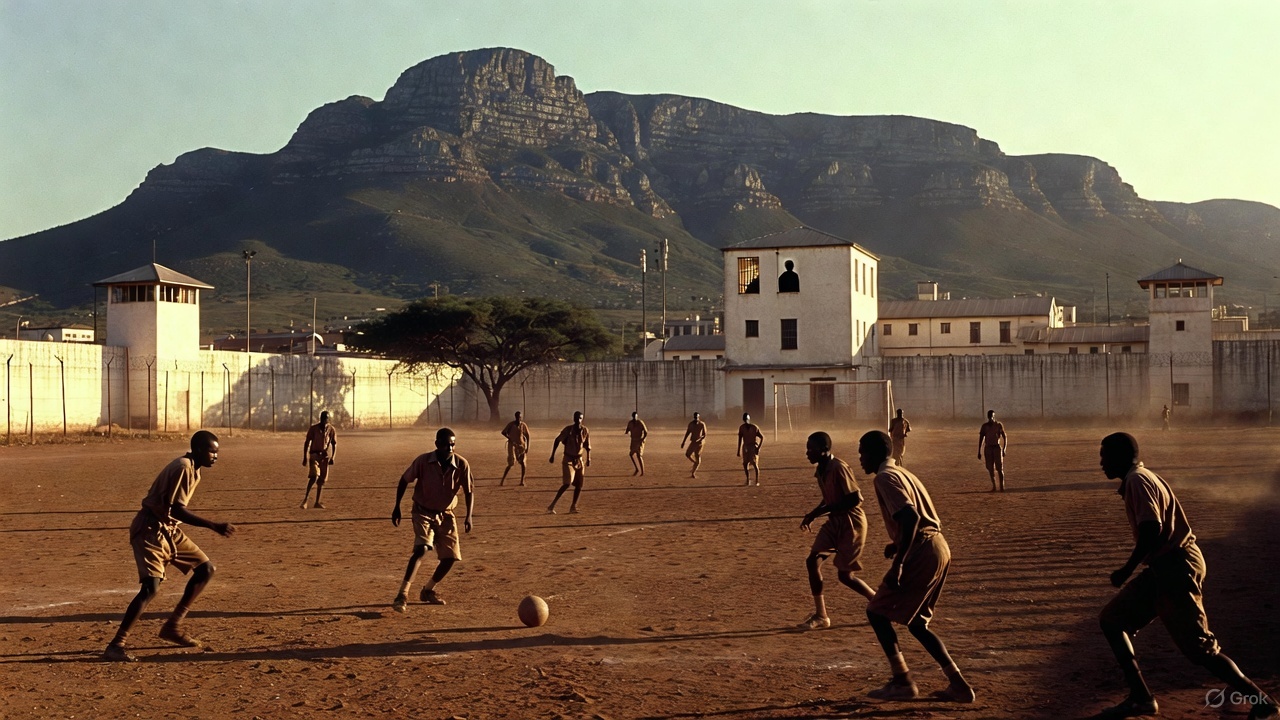
They didn’t have much greenery on the barren playing fields that were open to them. Their makeshift nets were fashioned from fishing ropes gathered from the shores around the island.
Their ball was sometimes reduced to rolled up pieces of paper stuffed into a sack, and they would sometimes be punished with beatings or solitary confinement if they asked for more. For years the political prisoners on Robben Island pleaded and protested with the authorities to be allowed to play football properly and their request was constantly refused.
By chance some of the inmates managed to get their hands on a copy of the prison regulation rule book and they began a concerted campaign to use the rules to their own advantage.
They discovered that a prisoner being detained for a period of 90 days or more was, by law, entitled to recreation. After three more years of petitioning the powers-that-be thought it prudent to give the inmates what they wanted. They figured that these men were too unfit, or too work weary, to take their recreation time seriously, and the movement would eventually wind-down. But they were wrong.
Under the guidance of an old FIFA guidebook that was copied by hand and distributed, they established the Robben Island Makana FA in 1966. The Makana FA was able to build a very successful three division league, in which hundreds of prisoners played a part.
There were roughly nine clubs who each ran three teams from a squad of around 50 men each. The former president of South Africa for example, Jacob Zuma, was a tough tackling centre back (and a dodgy referee), and a very good player by all accounts, along with his predecessor Thabo Mbeki’s dad and many more of the ANC prisoners that eventually went on to walk the corridors of power in the State that held them captive for so long.
Some players crafted boots from women’s footwear having become skilled at removing the heels and adding soles made of rubber tyres as studs. These men used football not only to keep themselves physically fit, but to also maintain their dignity in the struggle against apartheid. One former inmate, Lizo Sitito has said;
“Football saved my life. A person locked up and doing nothing cannot think. When soccer was there it gave us something to talk up about. That’s why it’s more than just a game”
For example, before he wrote his book More Than Just a Game, subsequently turned into a film, Chuck Korr came across a number of boxes labelled “Robben Island Sports” filled with hundreds of letters.
The typical nature of these correspondences included formal letters from, say, The Gunners FC, Robben Island, and addressed to the General Secretary, Makana FA, Robben Island, and would include complaints about poor refereeing decisions, requests for the rescheduling of matches, and suggestions to improve the league.
Despite the fact that these men worked, sweated, showered, ate and slept together, they still took the time to write to each other formally, and maintain a semblance of professionalism and civility in an environment that constantly sought to dehumanise them.
‘They loved football, of course … but it was also a way to show they could run things. They were showing they understood due process, even if it had not been legally afforded to them. It was about dignity and survival.’
Football not only entertained them, and nourished them physically; it also gave these political prisoners a sense of pride and purpose, while showing their captors that they were men of strength and integrity who would never be broken. Another former inmate and one of the league’s founders Anthony Suze says;
‘We played soccer on Robben Island with such passion and such detail – it was another way of survival . . . In a situation that sought to undermine us, it gave us hope. It is amazing to think a game that people take for granted all around the world was the very same game that gave a group of prisoners sanity and in a way glorified us.’
Of course, Mandela himself was barred from playing. They feared his influence over the other prisoners and had to contain it.
Although initially he was able to see his countrymen enjoying their recreation time, the authorities eventually took it upon themselves to build a concrete wall that would block his view. The authorities never gave any real reason for doing this other than that they were reinforcing his prison, wrapped in a jail, consigned to an island.
Draw your own conclusions. However, there is no doubt that the Makana Football League helped sustain Mandela and the others. The great man himself would later get a little access to football on Robben Island through the radio and siad;
“While we were on Robben Island, the only access to the World Cup was on radio. Football was the only joy to prisoners”
What started as the men playing surreptitiously in their cells using balls made of paper, cardboard and rags, grew into something that restored the pride, built the confidence, and literally transformed the perspective from which the prisoners would perceive their time passing.
Football gave them something to look forward to, it gave them a literal and figurative goal to aim for each week, it gave them a means to express themselves at a time where every effort was being made to oppress and suppress that self-expression.
Looking at modern football with its crass over-exposed media driven weekly crises, calamities and controversies, it is easy to forget the simple joys of playing the game in the spirit that it should be played. Mandela himself has said;
“Who could doubt that sport is a crucial window for the propagation of fair play and justice? After all, fair play is a value that is essential to sport.”
Mandela did also share some of the character traits we love to see in our football heroes. Commanding, elegant, stately, and hugely charismatic but humble, yet possessed of a nasty streak, and was well prepared to stick the boot in if necessary.
The inmates of Robben Island Maximum Security Prison for Political Prisoners, fought, kicked, and starved on hunger strikes; they spilled blood, took beatings and refused to withdraw their demands to play football, they demanded that which we all take for granted, the right to play. Marck Shinners, one of only four men to be sent to Robben Island twice, said;
“In football, there is a culture of transcendence. Football makes you transcend the area you find yourself in. People might not know you, but football gives you a sense of belonging.”
That’s why football is so much more than just a game.
P.S
The Makana F.A. was given honorary membership of FIFA in 2007.